
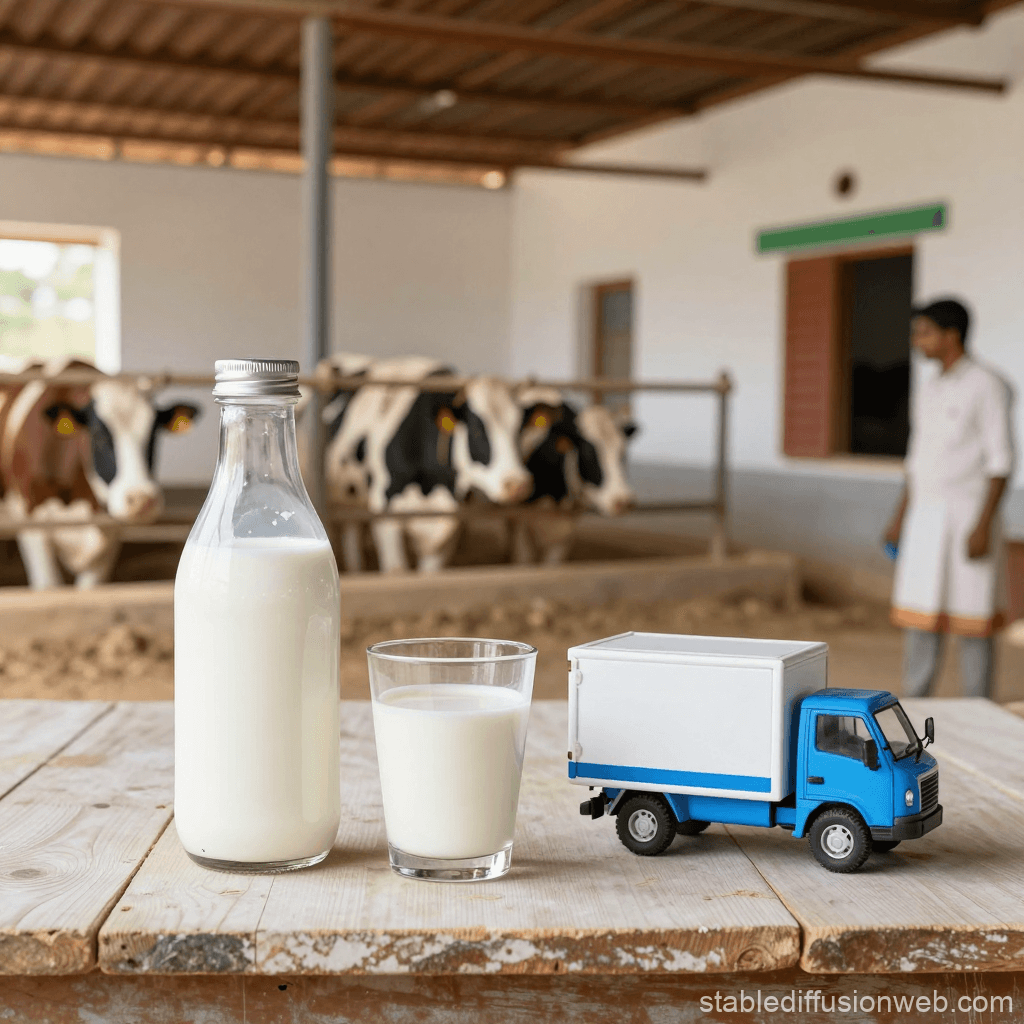
Short answer: single-origin milk is milk that comes from one farm and one herd, and is never pooled or mixed with milk from anywhere else. Every litre traces back to a single, known source.
That sounds simple, but it's unusual. Most milk sold in India is pooled: collected from many farmers, combined in bulk, and standardised before it reaches you. Pooling is what lets the country produce milk at enormous scale, and it's also what makes it nearly impossible to know where the milk in your glass actually came from.
This guide explains what single-origin milk means, how it differs from pooled milk, what it does and doesn't promise, and the questions to ask any brand that claims it. We're a single-origin dairy ourselves, so we'll be upfront about where we sit, and about the trade-offs.
What Does Single-Origin Milk Mean?
A milk is single-origin when three things are true:
One farm: all the milk comes from a single farm, not a network of suppliers or collection centres.
One herd: it comes from that farm's own animals, not milk bought in from neighbouring farmers and processed on-site.
No topping up: the brand doesn't blend in outside milk when demand rises or yields dip, not even occasionally.
The term borrows from coffee and chocolate, where "single-origin" tells you the beans came from one region or estate rather than a blend. For milk, the promise is narrower and stricter: one farm, end to end.
How Most Milk in India Reaches You
India is the world's largest milk producer, with an estimated 247.87 million tonnes in 2024-25, according to the Basic Animal Husbandry Statistics 2025 released by the Government of India. Much of it comes from small herds of a few animals each.
To turn millions of small herds into a reliable supply, the industry pools. A typical journey looks like this:
- Farmers bring milk to a village collection centre.
- It's combined in bulk coolers, then trucked to a chilling centre.
- Tankers carry it to a processing plant, where milk from many regions may be mixed again.
- It's standardised (fat and solids adjusted to a consistent spec), then packed.
This model, built largely by India's dairy cooperatives, is a genuine success story: it made the country self-sufficient in milk and gives millions of farming families a market. But it has a structural cost. By the time milk is packed, it's a blend of countless sources, and no one can tell you which farm your litre came from.
Single-Origin vs Pooled Milk
- Source: Single-origin: one farm, one herd. Pooled: many farmers, often across districts or states.
- Traceability: Single-origin: every litre traces to one known farm. Pooled: effectively untraceable once blended.
- Handoffs: Single-origin: few; farm to pack to doorstep. Pooled: many; collection centre, cooler, chilling centre, tanker, plant.
- Consistency: Single-origin: changes only with the herd's own seasons and feed. Pooled: standardised to a spec, which can mask what's in the blend.
- Supply: Single-origin: limited to what one farm produces, so it can sell out. Pooled: effectively unlimited.
- Price: Single-origin: higher per litre. Pooled: lower, thanks to scale.
Neither model is "wrong." They optimise for different things: pooled milk for scale and price, single-origin milk for knowing exactly where your milk comes from.
Why Single-Origin Matters
Accountability: with one source, there's nowhere to hide. If something is wrong with a batch, it traces back to one farm, one set of practices, one team, not a long chain of suppliers each pointing at the next.
Fewer points of entry for adulteration: adulteration happens at handoffs: wherever milk changes hands, there's an opportunity to dilute or tamper with it. A short, single-owner chain has far fewer of those moments. (If you want to check any milk yourself, see our guide to 5 home tests for pure milk.)
Honest consistency: pooled milk is standardised so it tastes the same all year. Single-origin milk can vary slightly with the seasons (richer in some months, lighter in others) because it reflects one herd's real diet and conditions rather than a blend engineered to a spec.
Knowing who to ask: when your milk comes from one farm, you can ask real questions (what the animals eat, how the milk is handled, when it was produced) and get real answers.
What Single-Origin Milk Does Not Mean
Because it's a less familiar term, "single-origin" sometimes gets bundled with claims it doesn't make. To be clear:
It's not a breed claim. Single-origin says nothing about which cows produced the milk. It's about the supply chain, not the animal.
It's not the same as A2. A2 refers to a protein type in milk. A single-origin milk may or may not be A2. The two are unrelated. (We explain A2 marketing in our buyer's guide to milk in Pune & Mumbai.)
It's not organic certification. Organic is a separate, certified standard covering farming inputs. Single-origin doesn't imply it.
It's not raw milk. Single-origin describes where milk comes from, not how it's processed. Always ask any brand how its milk is processed, whatever its source.
Single-Origin vs Untouched: Two Different Promises
These two terms often appear together, but they answer different questions.
Single-origin answers "where does it come from?": one farm, never mixed.
Untouched answers "how is it handled?": the milk is never touched by human hands on its way to you. It moves through sealed, automated systems from milking to packing, closing off the contamination and tampering that manual handling allows.
A milk can be one without the other: a small farm could sell only its own milk but milk and pour by hand, and a large plant could be highly automated while blending thousands of sources. Doodh & Co is built to be both.
How to Check if a Brand Is Really Single-Origin
"Single-origin" isn't a regulated term in India, so it's worth asking a few direct questions:
1. Can you name the farm? A single-origin brand should be able to say which farm its milk comes from, and that it's their own.
2. Do you ever buy in milk? Ask specifically about summer, when yields drop and demand doesn't. Topping up with outside milk during lean months breaks the single-origin promise.
3. What happens when you run out? An honest single-origin brand sells out sometimes, because one farm can only produce so much. A brand that never runs short, no matter how fast it grows, is worth asking more questions.
4. Check the FSSAI licence. Every dairy must hold an FSSAI licence, and you can look up any licence number on FSSAI's FoSCoS portal (foscos.fssai.gov.in) to see the licensed business and the kind of licence it holds.
Clear, specific answers are a good sign. Vague ones, like "sourced from trusted farms" or "carefully selected partners," usually mean pooled milk.
How Doodh & Co Does It
Doodh & Co is a single-origin dairy delivering in Pune and Mumbai. Here's what that means in practice:
Our own farm only: every litre comes from our own farm. We never buy in milk from other farms or mix it, including when demand outpaces supply.
Untouched: the milk moves through sealed, automated systems and is never handled by human hands before it reaches your door.
Licensed and verifiable: we're an FSSAI-licensed dairy manufacturer (Lic. No. 11526088000179, VCL Dairy and Dairy Products Pvt. Ltd.). You can look the number up yourself.
Limited by design: because we don't top up with outside milk, products sometimes sell out. When that happens, you can join the waitlist and we'll text you when it's back.
See our delivery areas in Pune and Mumbai, browse our milk and dairy, or set up daily delivery with a subscription.
Conclusion
Single-origin milk comes down to one idea: knowing exactly where your milk comes from. It means one farm, one herd, and no blending: a small promise that's surprisingly rare in a system built on pooling.
It isn't a breed claim, an A2 claim, or an organic label, and it comes with honest trade-offs: a higher price and limited supply. What you get in return is a short, accountable supply chain you can actually ask questions of.
If that matters to your family, see how Doodh & Co delivers single-origin milk in Pune and Mumbai. And if you're still comparing options, our honest buyer's guide walks through every category of milk brand available in both cities.